Thursday, December 4, 2014

This semester's Civics & Economics class had a great visit to the Virginia State Capitol on November 24th.  For the first hour of the visit, we explored the Capitol with our guide.  The building is a showcase for the history of our Commonwealth, with artwork, artifacts and statues from Virginia's earliest days to the present.  Among the biggest hits with the kids was the life sized bronze statue of Albemarle County's most famous resident, Thomas Jefferson himself.
In his hands, Jefferson is depicted holding the plans for the Capitol which he designed from ancient Roman architecture he had studied in France.  Since we didn't have the marble he adored there, workman instead built the capitol out of brick covered in white painted stucco to make it look like marble.  Even the columns in front of the capitol are brick stucco over the trunks of massive trees cut to make them solid and straight.

The rotunda and its statue of George Washington were equally impressive, with the finely carved details cut into the marble such as tassles on Washington's uniform and the facial details copied from a plaster life cast of Washington's face.  As the tour guide commented, "Washington was a stickler for details, perserverance, and most of all manners.  Washington would have gladly accepted as visitors to his home such wonderful well behaved and polite children as Walton Middle School students."  Underfoot were ancient fossils preserved in the stone tiles laid in the floor of the rotunda.

After our tour, we were brought to the Chamber of the House of Delegates for their presentation.  An overview of the struture and rules for the chamber was followed by a lively legislative lawmaking session.  The kids elected a Clerk, Mr. Feiner, who read aloud the bill and a Speaker of the House, Madam Speaker Scott, who presided over a lively debate on the proposed bill from Delegate Morris.
 This education bill proposed segregating students into gender specific classrooms in order to improve student academic performance.  Debate was well thought out and articulately presented, ending with a vote of 6 Ayes and 39 Nays to defeat the proposed legislation. All and all, the kids came away with a new appreciation for the responsibility and difficulty of being an elected representative for the people of Virginia.

Monday, December 1, 2014

6th grade Language Arts and Science Classes Collaborating!

We have been in school mode full swing this month, and teachers have been working together to help develop students writing skills. Being able to communicate clearly through the written word is a powerful skill that all students will use throughout their lifetimes. We live in a world full of social media and texting, but there will be times when our students will need to write in a more formal fashion.

Writing essays and stories have been a part of our regular routine this year. In order to show students that we write for a variety of purposes Ms. Cabrera , Mrs. Kauffman, Ms. Tabasso and myself have teamed up to work on a science writing project. Students are developing a story based on a character that is living in a time when all the fossil fuels have been depleted, and they must use other energy sources for the power in their lives. Students have options to create a short story, a script, a story book, or a graphic story. They have been very creative in their use of story elements and plot lines. Some of the best work will be displayed in the media center after Thanksgiving break. Happy Writing to you students and teachers!

Monday, November 17, 2014

6th Grade Math Represents!

Welcome to the first blog from Mr. Hicks’ 6th Grade math!  Over the past several weeks, we have been representing!  Kinda.  An essential skill that must be solidified this year is the ability to show fractional values, in a variety of different ways.  In early October, we started our unit on ratios.  Students were responsible for knowing that a ratio is chiefly a part to whole comparison.  Also, a ratio IS a fraction.  So, a real life example would be that our class has an 8:24 boy (part)-to-whole ratio.
 Our next set of skills was being able to turn fractions into decimals.  We learned three main strategies to turn fractions into decimals.  Please find one of my students and ask for a demonstration!  After this skill was learned, we spent a little time turning decimals into percents.
Near the end of October, we applied our new skill sets to some real-life and REAL-FUN activities!  See below:

Our Skittles math activity was a BLAST!  After the students opened their bags of Skittles, they were to write the flavors as ratios, fractions, decimals, and percents.  My favorite part was seeing the students applying their estimation skills while creating beautiful handmade pie graphs.  
As a follow-up activity, we took our data and found two different ways to create pie graphs with our laptops.  One way was to enter the data into an Excel spreadsheet and then transfer to a graph.  We then compared our handmade graph to the computer graph to analyze how accurate we were.
Finally, we were lucky enough to have the opportunity to work with some ipads and create a video tutorial!  The students were actually teaching the unit that they had just learned by using ipad apps and then editing the video on Movie Maker on their laptops!  Although we ran into the usual technical difficulties, the students learned a ton!
We are now on to adding, subtracting, multiplying, and dividing fractions! 

Friday, October 31, 2014

Currently in The Art Lab!

There are only a few art projects I repeat. This may change. I have only been teaching art, officially, for 7 years. With approximately 5 projects each semester, and 2 semesters each year, and 3 different levels, that makes 210 different opportunities to teach a new lesson. Block Printing is unique though, and I include it EVERY semester. Of all the mediums, it requires the most planning, much critical thinking/problem solving, and also the most courage.
However, my first year I wrote up this lesson for block printed portraits, and it works so well, I keep doing it. And I always teach it to my 6th graders. It plugs into the Visual Arts SOLs for their level well, and it just seems to WORK. Print making is the medium I enjoy teaching them the most, at all levels. But this project takes the cake. I have adjusted it in little ways depending on the group of students, and also on an individual basis. Some students do not want to embark on a self-portrait. This semester I suggested they exchange photos with a classmate. A few chose to do so. Some want to honor someone else in their life. Last year, I had a student insist on basing her block carving on a portrait of her and her mother. Possibly I like this project so much because it provides the opportunity to really MEET the new students. Part of this project incorporates choosing words that describe the subject’s personality. It is fun to hear them talk about these with each other. I have them make a list on their own and then switch with a partner and have them add words that describe each other’s personality traits, from a different perspective. 


The students LOVE carving the blocks, at all levels. I find it to be the most all-inclusively engaging medium.  Most all the students become entranced while working on their blocks. I have to snap them out of it when it is clean-up time, and its not always easy!

The 7th graders are working on digital collages as the material for their blocks. They each created their own digital collage, with a minimum of 3 different images tied together with a specific theme or narrative. This is very challenging for some, but there are always a few that blow me away. One of my 7th graders this semester combined an image of a businessman, an airplane, and a pedestal, all in a landscape. When I asked him about the theme he described how it was a twist on the way infants are sometimes fed by a pretend game of the spoon being an airplane, flying into an open mouth. Brilliant and witty! 


The 8th graders our carving two-sided blocks in which they are designing their own playing card, Tarot style card, or “affirmation” card.  The 8th grade art class is a very eclectic group of students. It is my largest class, and one of my more challenging ones. It’s been a slow going project! I will post an update with images of their blocks as they make more progress.  Their ideas range from intricate design based traditional playing card styles, to designs reflecting the love of sports (replacing the usual spades, hearts, clubs etc.…with softballs or lacrosse sticks) to interesting symbolism inspired by the Tarot tradition (which, by the way, originated as an Italian Card game…so it was not always “ fortune telling”).

It is such a gratifying and rewarding experience to observe my students connecting with their own creativity. Especially when they came into the class claiming they are not artists! Watching them come in and get right to their projects, enthusiastic and focused, is a wonderful thing to see. I am grateful to be their teacher and guide in Walton’s “ Art Lab”.


Monday, October 27, 2014


Get Ready for Walton's Friday Night Bash on Friday, November 14th! All students from Walton's feeder pattern in grades k-8 are invited.

Walton's Book Fair will also be open!

This event is free to the Walton Community and refreshments and dinner items will be sold.

Click on the link below to reserve your spot today!

https://docs.google.com/a/k12albemarle.org/document/d/1G6FLiTVPoNBvk1bjOlZXf7fea3xX6ZjdY_c4sZzfnPs/edit?usp=sharing

Monday, October 20, 2014

Locker Rumors

LOCKER RUMORS

Here’s what’s happening in the world of Health and Physical Education.

We have a new face in our department (at least until December 12):   Phil Vargas joins us as a student teacher from the University of Virginia.  Mr. Vargas completed his elementary training at Broadus Wood and now brings his skills to bear on our middle school students.

Our guidance department shared some valuable information with our 6th and 8th graders.  6th graders enjoyed conflict resolution activities, while our 8th graders participated in stress management techniques.  Special thanks to Ms. Crawford and Mr. Bloor.

Our 7th graders completed their body system presentations.  We were treated to several entertaining methods of presenting this material:  Power Point; skits; posters; and models to name several.

Walton’s World Series continues this week. Students will be tested on softball skills, rules, player positions, and game strategy.

Get outside and enjoy the cool autumn air!


Diane Archer, Health & P.E. Teacher

Monday, October 13, 2014

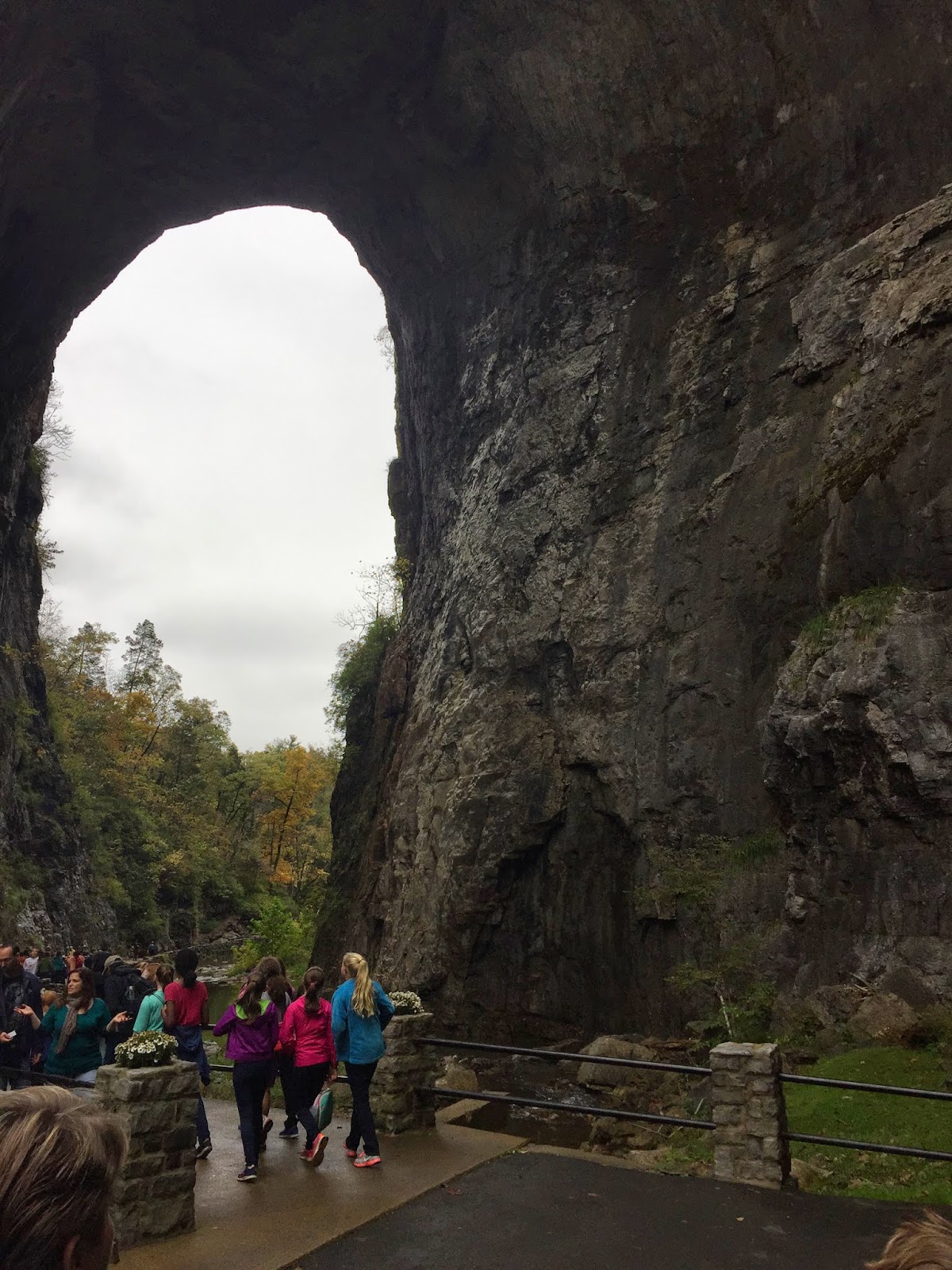
6th Grade Natural Bridge Field Trip by Ms. Tabasso


Today, the sixth grade students of Walton Middle School traveled 90 miles southwest to Rockbridge County to visit Natural Bridge.  This was a culminating trip for the current social studies students, who have completed two projects about Native American tribes in North America.  The second semester social studies students have established some great background knowledge by attending this trip that they will be able to use during their studies in January.

You may be asking yourself, What exactly is Natural Bridge?  Well, Natural Bridge is just that a natural bridge that was carved out by Cedar Creek, a tributary of the James River, thousands of years ago.  The Native American Monacan tribe considered it to be a scared place after a victorious battle over the rival Powhatan tribe on the site.  White settlers discovered Natural Bridge in March of 1749, and it is also believed that George Washington may have even traveled to Natural Bridge while surveying the area.  The initials GW can be seen about 23 feet from the top of the bridge giving proof that he was there.  George Washington is not the only president who is tied to Natural Bridge--the land Natural Bridge is located on was acquired by Thomas Jefferson in 1774.  It served as one of the first tourist attractions to visiting Europeans in the 18th and 19th centuries.  Fast forward to modern day, it is still a place of mystic and wonder, especially to our sixth graders today!

We choose a perfect autumn day to visit.  The temperature was quite comfortable—not too hot and not too cold.  Although the sky seemed rather ominous, the rain held off and we were able to stay dry!  As soon as we arrived, students hopped off the bus and stretched their legs—an hour and forty five minutes was a long time for those little legs to be cramped up!  We made our way down 137 stairs to the base of Natural Bridge.  We experienced breath-taking views, and many students pulled out their phones and cameras to document the nature beauty.  We continued to make our way along a trial next to the creek and under the amazing bridge.  There were mini-traffic jams as students “ooh-ed” and “aahh-ed” with open mouths as they gazed all the way up!  

We rounded under and past the bridge and a little bit farther up the path, we came upon a Monacan village.  There were two guides who were able to provide the students with a tour of the village.  They were very helpful along the way and taught the students new things specifically about the Monacan tribe.  They even got to say a few Monacan words.  The first stop was a traditional Monacan house.  Then the students checked out the “kitchen”.  Most were really excited about seeing the kitchen, given that fact that it was just about lunchtime!  They learned about the top three foods cooked by the Monacan—deer, turkey, and turtles.  Turtles were the best because they had their very own serving bowl.  They also were shown steel knives and a copper pot acquired by the tribe by trading.  They also saw the predecessor to the steel knifes—rock knives that you had to be extremely careful not to break.

We made our way to a longhouse where the Monacans would hold important meetings.  They even had a fire going inside of the longhouse, which made it a tad bit smoky, but mostly cozy.  They also saw a trading post and learned more about the tools and communication Monacans used.  At one point, the guide blow on a conch shell, and the students learned it was used to signal an upcoming battle.  Macy commented, “#Shellphone!”  We ended our visit eating lunch just outside of the Monacan village.  All in all, the students learned a lot and got to spend a lot of time in the great outdoors experiences a bit history and natural beauty!